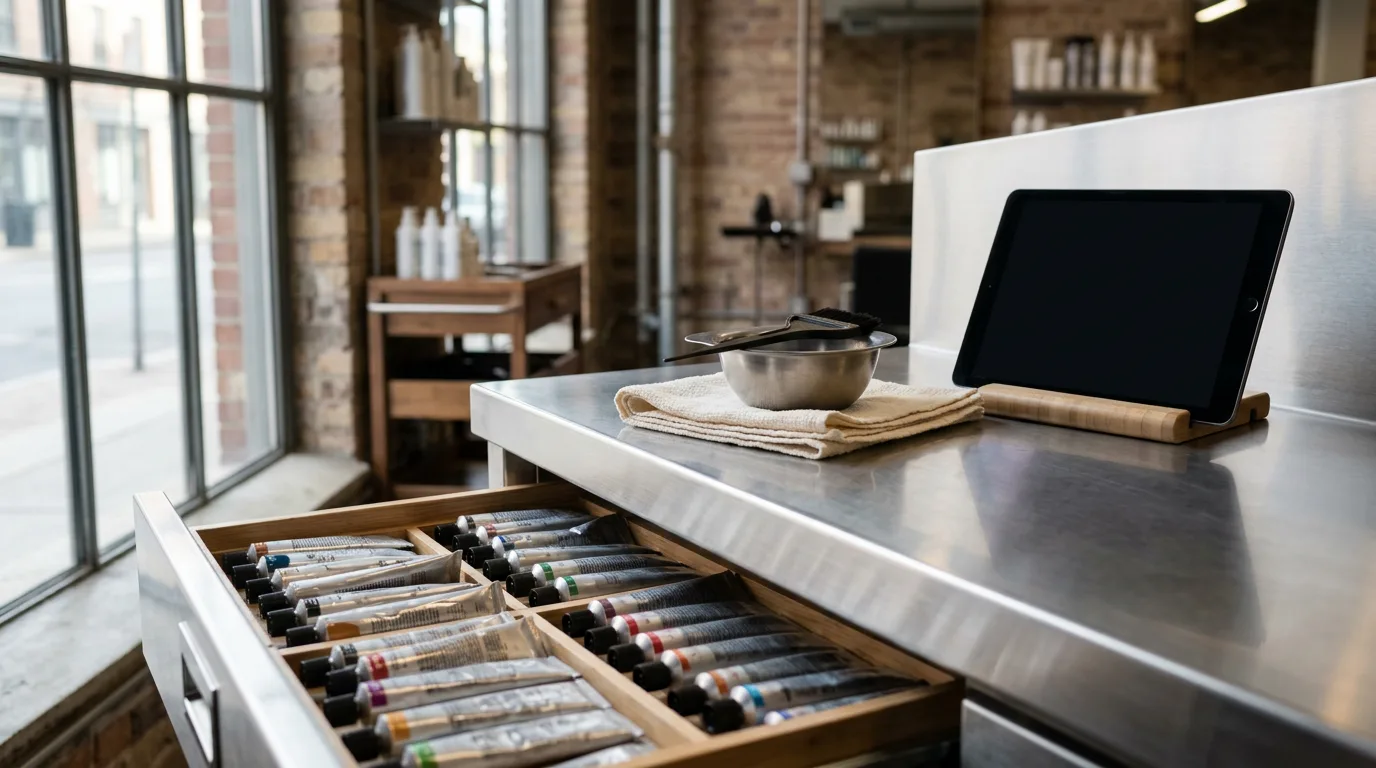
What does a colour service cost you in product?
Nobody can tell you from the outside. Your product cost is the weight of colour and developer you actually mix, plus the toner, the bond builder, the foil and the gloves, priced from your own invoices. Weigh each bowl, log it, and you have the number for your salon.
Most owners carry a number in their head. It came from a class, a rep, or a figure somebody said out loud at a trade show. It is not your number. Your number depends on what line you buy, what you pay for it, how long your client's hair is, and how much colour goes down the drain at the end of the day.
The good news is that this is one of the easiest costs in a salon to measure exactly. Colour is weighed. Weight is a fact. You do not need a system or a consultant to find out what a colour service costs you in product. You need a scale and a week of writing things down.
$73 is the median price of a colour service across Hairvana salons.[1]
Whatever you charge, the product comes out of that price first. So does your time, your rent, your card fees and your laundry. If you have never separated the product out, you are guessing at how much of the ticket is actually yours.
Weigh the bowl, not the tube
A tube is an estimate. The scale is the fact. Put a digital scale on your colour bar. Set the empty bowl on it and zero it out. Mix the way you always mix, then write down the grams of colour, the grams of developer, and which shades went in. Do it before you walk to the chair, because you will not remember after.
Do the same for the bowl you mix at the backwash. Toner and gloss get forgotten more than anything else on the colour bar, and they come out of the same invoice.
Leave the scale switched on
A scale that lives in a drawer never gets used. Keep it out, plugged in, next to the colour. The habit you are building is weighing before you mix, not weighing when you remember.
What to log for every client
- The service name as it appears on your menu, so the log matches your price list
- Grams of colour, broken out by shade
- Grams of developer, and which developer
- Toner or gloss, weighed the same way
- Bond builder, by the scoop or by the pump
- Back bar shampoo and conditioner, by the pump
- Foils, wraps, cotton, gloves, barrier cream and the cape liner
- Anything you threw away because you mixed more than the head needed
Keep logging until the pattern repeats itself. A root retouch on a short head will land in the same place again and again. A full head of foils on long hair will land somewhere else. Those are two different costs, and if your menu prices them the same, one of them is paying for the other.
What counts as product cost on a colour service?
Everything you open for that client. If you redo the colour, that extra bowl counts too. Price every line from the invoice you actually paid.
Owners tend to count the tube and stop. The small items are the ones that quietly eat the ticket, because they get opened without a thought. Gloves are product. Foil is product. The towel you stained is laundry, which is not product, but it is still a cost of the colour service, so write it somewhere.
Turn invoice prices into a cost per gram
Take the invoice price of a tube and divide it by the grams in the tube. That is your cost per gram for that shade. Multiply it by the grams you logged, and you have the colour cost for that client. Do the same for developer by the bottle, bond builder by the container, and back bar by the litre.
Use the price you paid, not the price on the price list. Distributor deals, buy-one-get-one promos and shipping all move the real number. If you bought a case on promotion, your cost per gram for that case is lower, and your cost goes back up on the next order.
Once you have done it by hand, you will not want to do it by hand again. A system that holds what each item cost you and how much you used turns the whole exercise into a report instead of a notebook. That is what inventory management is for.
Where product cost leaks
- Mixing before the consultation. You guess the head, then you guess again and mix more.
- Over-mixing by habit. The bowl gets filled to the same line every time, whatever the head needs.
- Unlabelled back bar bottles. Nobody knows what went in them, so nobody counts them.
- Redos. A colour that has to be corrected spends product twice and time twice.
- Decanting into unmarked pumps, so the expensive treatment gets used like conditioner.
- Taking the stylist's word for the formula instead of writing it in the client record.
A redo costs you the whole bowl again
Timing rules exist for a reason. The U.S. Food and Drug Administration advises, "Wait at least 14 days after bleaching, relaxing, or perming your hair before using dye." Booking inside that window invites the correction you will pay for twice.[2]
Do smoothing services belong in the same cost math?
Yes, and add the air to the list. The U.S. Food and Drug Administration says that when formaldehyde is present in the air above 0.1 ppm, some people may experience watery eyes, burning in the eyes, nose and throat, coughing, wheezing, nausea and skin irritation. Ventilation and protective gear are part of what that service costs you.[3]
Price those services with the same method. Weigh what goes on the head, count the gloves and the masks, and add the cost of running the service safely. If a service needs equipment the rest of your menu does not, that equipment belongs in its price.
Your colour line is a cost decision as well as a craft one
Two lines can give you the same result on the head and a different number at the bottom of the ticket. Once you know your cost per gram, you can compare lines honestly instead of comparing swatch books. You can also see which shades are expensive enough to deserve their own line on the menu.
Professional hair care from QAI Hair
Know what every item costs you before it goes in the bowl. Professional hair care from QAI Hair.
How do you price a colour service once you know the product cost?
Start from your own measured cost, not the salon down the street. Add your time at the rate you want to earn, then a share of rent, card fees and laundry. That gives you a floor. Set the menu price above the floor, then check it against what your market pays.
Long hair, extra foils and a second bowl of toner are not goodwill. They are cost. Put them on the menu as named add-ons with their own prices, and tell the client at the consultation, not at the register. A named charge gets accepted. A surprise does not. how to price salon services
If your floor comes out higher than your current menu price, you have two choices: charge more or use less. Most owners find they can do both. Raising the price works better when the rest of the experience is worth it, which is what a premium pricing approach is really about. premium salon pricing strategy
Product is one line in a much longer list. Rent, insurance, software, card fees and laundry all have to come out of the same ticket, and the colour cost only means something next to them. every monthly cost line in a salon
What to do next
- Buy a digital scale and leave it on the colour bar.
- Weigh and write down every bowl for your next run of colour clients, toner included.
- Pull your last invoices and work out a cost per gram for the shades you reach for most.
- Multiply grams by cost per gram for each service type on your menu.
- Compare the result to what you charge, and fix the service that loses money first.
- Write the formula in the client record so the next visit mixes right the first time.
Do it per service, not per salon
One average colour cost across your whole book hides the problem. A retouch and a full head of foils are different services with different costs. Measure them separately or you will keep underpricing the long one.
Frequently asked questions
What percentage of my colour price should product be?
There is no safe figure to borrow, because it depends on your line, your invoice prices and the length of hair you work on. Measure your own bowls and your own invoices. The percentage is an output of that work, not a target you set first.
Should I charge for bond builder separately?
Either way works, as long as it appears somewhere. Build it into the service price, or list it as a named add-on with its own price on the menu. What fails is doing it for free and absorbing the cost every time.
How long after bleaching can a client have colour?
The U.S. Food and Drug Administration advises waiting at least 14 days after bleaching, relaxing, or perming your hair before using dye. Build that gap into how you book the follow-up visit so you are not paying for a correction later.[2]
How do I stop my team over-mixing?
Weigh every bowl and log it, and mix only after the consultation is done. When the formula and the grams live in the client record, the next visit starts from a known quantity instead of a habit.
Sources
- Median price of a colour service across Hairvana salons
- Hair Dyes (U.S. Food and Drug Administration)
- Hair Smoothing Products That Release Formaldehyde When Heated (U.S. Food and Drug Administration)